Six Toys on a Shelf: The Monthly Rotation That Changed Our Living Room
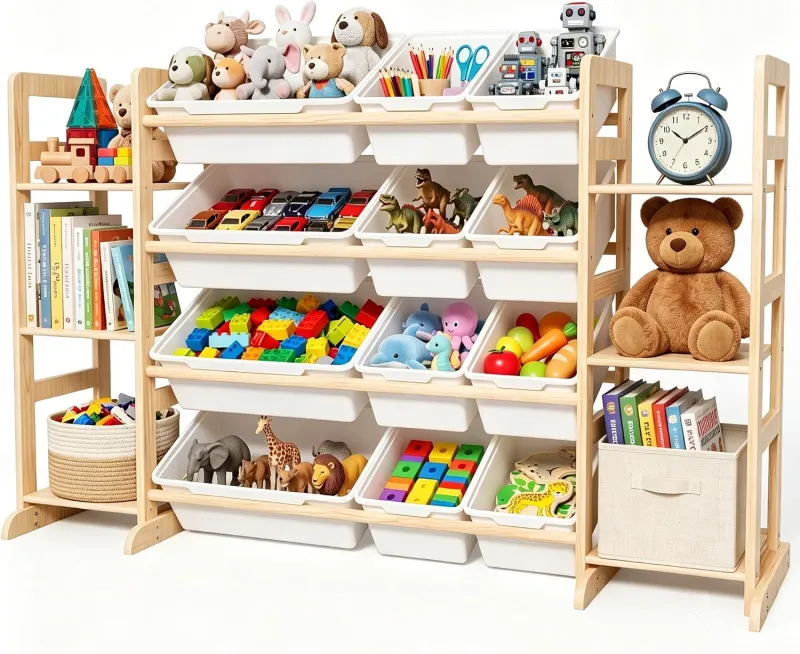
Photo: minimalist playroom shelf with wooden toys toddler, via m.media-amazon.com
There's a word hiding in our site's name that we don't talk about enough: kecil. Small. In Indonesian homes, smallness isn't a compromise — it's a design choice. The little wooden stool in the corner. The single bowl of crackers set out for afternoon guests. Things are kept few on purpose, so each one matters.
We bring this up because somewhere between the third birthday party and the December holidays, the average American playroom stops being a room and starts being a landfill with a rug. If you've ever stepped on a LEGO at 6 a.m., you already know the feeling. But here's the thing we learned the slow way: the problem isn't your kid's love of toys. It's the volume. And the fix takes one afternoon and about six plastic bins.
The Math Nobody Told Us About
Child development researchers have been quietly saying this for years: kids with fewer toys available at once play longer, deeper, and more creatively. A well-known University of Toledo study found that toddlers with only four toys engaged in substantially more creative play than toddlers with sixteen. Sixteen toys isn't abundance to a three-year-old. It's noise.
When everything is out, nothing gets chosen. Kids flit from one thing to the next like they're scrolling. When there are just a few things out, a cardboard box becomes a rocket ship, a measuring cup becomes a soup ladle, and the same old dump truck gets a whole new storyline.
How to Build Your First Rotation (in One Afternoon)
You don't need a Montessori certification or a labeling machine. You need a Saturday nap time and some honest hands.
Step 1: Gather everything. Yes, everything. Pile it in the living room. It will look worse before it looks better. That's normal.
Step 2: Sort into three piles. Loved (played with weekly), forgotten (haven't touched in months), and outgrown or broken (donate, pass along, or toss). Be ruthless with pile three — you're not throwing away childhood, you're clearing the runway for it.
Step 3: Pick six to eight toys for the shelf. Aim for a mix: something to build with, something to pretend with, something physical (a ball, a balance board), a book or two, and one puzzle or game. Resist the urge to keep the favorites out permanently — even beloved toys get a rest, which brings us to the magic part.
Step 4: Bin the rest and hide them. Closet, garage, under the bed. Out of sight, truly out. Label the bins 1 through whatever if you're the organized type, or just grab whichever one feels right next month.
Step 5: Swap monthly, not more. Set a phone reminder for the first Sunday of the month. Trade out a few toys, return a few. Here's the part that surprises every parent: toys coming back from the bin get greeted like old friends. Your kid will play with the toy they ignored for six weeks like they just unwrapped it on Christmas morning.
What We Noticed After Two Months
The living room got calmer — cleanup went from a twenty-minute battle to a two-minute tidy, because everything has one obvious home. But the bigger change was in the play itself. Our five-year-old started building multi-day LEGO projects because the pieces weren't buried under forty other abandoned things. Our toddler stopped the whine-spiral of "I'm bored" said while standing in front of a fully stocked shelf.
A simpler play space also does something quieter: it teaches that contentment doesn't come from the next new thing. In a house where toys appear and disappear on a rhythm, kids learn that what's out is enough. That's a kecil lesson if there ever was one — small, intentional, and bigger than it looks.
A Few Honest Caveats
Keep out anything comfort-adjacent — the stuffed rabbit doesn't rotate, ever. And if your kid is going through a big developmental leap or a hard stretch (new sibling, new school), maybe skip a swap that month. Rotation serves the child, not the system.
Start with six toys. See what happens. The pile in the closet can wait — it's been waiting for months anyway.