It Takes a Village, But Nobody Lives in Yours Anymore

The House Was Full
My friend Dewi grew up in Surabaya in a house where the front door was basically decorative. Her grandmother slept in the room next to hers. Her aunt lived two doors down and fed her breakfast most mornings whether she asked or not. When Dewi's mom worked late, nobody scrambled for a babysitter. There was always someone.
Now Dewi lives in suburban Ohio with two kids, a garage full of stuff, and a family group chat that spans twelve time zones. Her kids know their grandmother mostly as a face on a phone screen who appears every Sunday at 4 p.m. sharp.
Dewi's not doing anything wrong. She's just living the default American arrangement: one household, two parents, kids, and a lot of logistics. It's the loneliest setup we've ever normalized — and we rarely talk about what our kids are missing because of it.
What Kids Actually Get From the Village
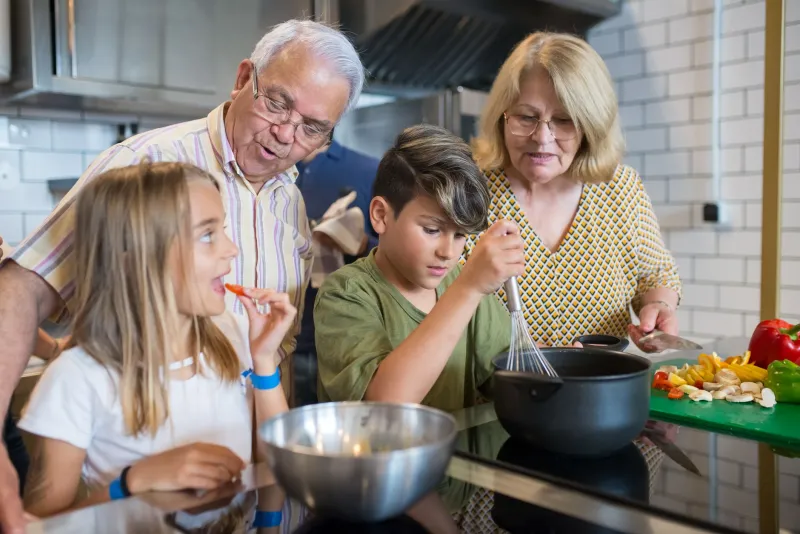
We tend to frame grandparents and extended family as a childcare solution, which undersells it badly. What a multi-generational circle gives a child is harder to buy and impossible to schedule:
More than one way of being loved. A parent's love comes with the weight of responsibility. A grandparent's love is famously lighter — indulgent, patient, free of the daily friction over homework and screen time. Kids need both flavors.
Witnesses to a longer story. When a child hears their grandmother talk about arriving in a new country with one suitcase, or their grandfather describe the town before the highway, they learn they belong to something older than themselves. Psychologists call this the "intergenerational self," and it's strongly linked to resilience.
Looser supervision, safer risk. Ask any adult raised in a village (literal or figurative) and they'll tell you about the aunt who let them crack eggs, the uncle who let them hold the power drill. Extended family gives kids adults who say yes a little more often than mom and dad can afford to.
The sight of aging, up close. Kids who spend real time around older people learn that growing old is normal, not scary. That lesson doesn't come from a picture book.
How the Gap Got So Wide
American families didn't stop living near each other out of malice. We did it chasing jobs, affordable housing, and school districts. The average American now moves more than eleven times in a lifetime, and each move thins the web a little more.
Indonesian families made different trade-offs. Multi-generational households are still common there, and the concept of gotong royong — mutual aid, everyone carrying a little of the load — is a cultural backbone. The village isn't a nostalgic slogan; it's infrastructure.
Here's the honest part: some of what we traded for distance was worth it. Independence, privacy, escape from family friction. But we overcorrected. We went from a village to an island, and we're raising kids on that island with two exhausted adults trying to be everything at once.
Rebuilding It, One Ritual at a Time
You can't relocate your whole family (though if you can, call your mother). But you can get deliberate. Distance shrinks a relationship only if you let it.
1. Make the video call a ritual, not a check-in
A Sunday call with no agenda dies in three weeks. Give it a shape. Sunday dinner where grandma "eats" with you over the phone. A grandparent who reads one bedtime story a week over video. Kids don't need long calls — they need predictable ones.
2. Send things that can be held
A drawing mailed to Grandpa, and a postcard back, does something a text never will. Physical objects are how young kids understand that love travels.
3. Adopt the elders you already have
Your kids' village doesn't have to share their DNA. The retired neighbor who waves every morning. The older couple at church, the library, the bus stop. Ask if they'd like to be "grandma for a day" at the school bake sale. Surrogate grandparents are real, and both sides tend to be starved for exactly this.
4. Trade the playdate for the porch
Villages form through low-effort, high-frequency contact — not scheduled activities. Front yards, shared dinners with neighbors, kids underfoot while adults talk. It's slower and messier than a booking system, but it's the only thing that actually builds a village.
5. Tell the family stories out loud
Even far away, you are the bridge. Tell your kids about your grandmother's hands, your aunt's terrible jokes, the house you grew up in. Kids can't miss what they've never heard of.
A Short Guide for Far-From-Home Families
If you're starting from scratch, keep it simple:
- Pick one recurring slot — one call, one day, same time. Consistency beats length.
- Give the elders a role, not an audience. Ask them to teach something: a recipe, a song, a card game.
- Create one annual anchor — a summer visit, a holiday trip — that kids can count on all year.
- Name your neighbors' roles. "Ms. Chen is like a grandmother to you" gives a child permission to love outside the family tree.
The Tree Grows Sideways Too
At Kecil Pohon — little tree — we think a lot about how things grow. A tree doesn't just grow up. It spreads roots wide, leans on neighboring trees, shelters whatever grows underneath it.
Kids are the same. They don't just need parents. They need the whole grove: the grandparents on video, the aunts in the group chat, the neighbor who knows their name. The village your kids are missing isn't gone. It's just waiting for you to pick up the phone, walk next door, and plant the first seed.