Your Kid Doesn't Need a Bigger House. They Need More People In It.
Here's a stat that should bother us more than it does: the average American kid spends a startling amount of their week alone with one or two adults. Maybe three, if you count the school bus driver. Meanwhile, in much of Indonesia, a child's daily cast of characters includes grandparents, an aunt or two, cousins, and often a neighbor who has known them since birth and feels fully entitled to tell them to stop running.
We have a name for that in English, sort of: "it takes a village." We say it on nursery wall art. We rarely mean it.
The Nuclear Family Is a Very New Experiment
Indonesian family life often runs on what researchers call multigenerational co-residence — grandma and grandpa living under the same roof, or a door or two away. That's not nostalgia; it's logistics, and it works. Grandparents handle school pickup. An uncle teaches the kid to ride a bike. A great-aunt is the one who slips them an extra piece of fried banana and tells the story behind it.
American families, by contrast, have spent the last seventy years optimizing for independence: kids out, parents in, everyone commuting. The result is what sociologists have started calling the "grandparent gap" — children who see their elders a few times a year, on holidays, in photos.
And here's the thing the child development folks keep telling us: kids don't just benefit from more caregivers. They need them. Multiple adult relationships build resilience, language, and that quiet sense of being held by more than your own immediate household. One grandparent alone can't be the whole safety net. Neither can one exhausted parent.
You Don't Have to Move to Jakarta
The good news: the village doesn't require a plane ticket or a zoning variance. It requires a standing invitation.
A few small moves that actually stick:
- Adopt the weekly meal. Pick one night — Sunday works — and make it non-negotiable. Rotate houses if you have local family. If you don't, rotate friends. Consistency beats grandeur.
- Recruit "borrowed aunties and uncles." Every family I know with a strong village has at least one adult who isn't related by blood but shows up anyway. The retired neighbor. The college friend two streets over. Give these people titles. Kids rise to meet the roles we name.
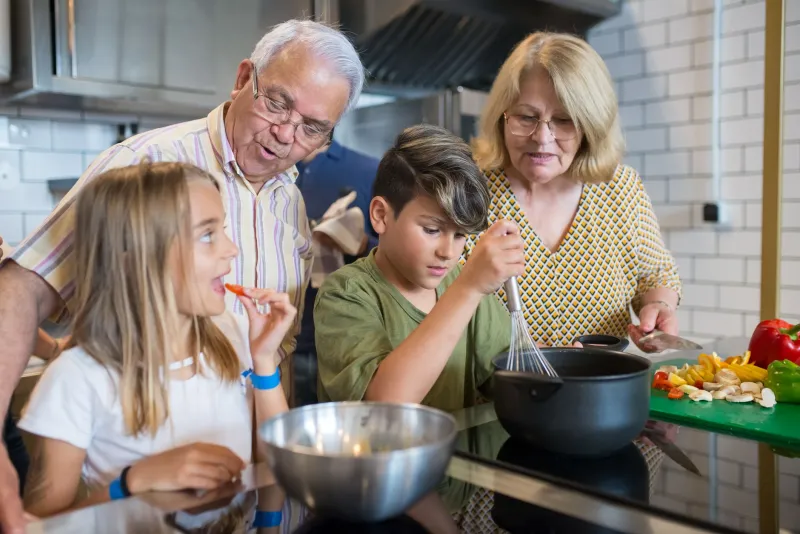
- Hand elders actual jobs. Not symbolic ones. Let Grandma run the pancake station. Ask the neighbor to teach your kid chess. People invest in what they're responsible for.
- Loosen the door policy. In a lot of Indonesian neighborhoods, doors are functionally open and dropping by is a given. You don't need to replicate that exactly, but a "just come in" text thread with three families gets you surprisingly close.
What the Kids Actually Get
Ask a grandparent what they want and the answer is rarely a gift — it's to be useful. That's the trade we've forgotten. We treat elders as people to visit instead of people to depend on, and everyone ends up lonelier for it.
Meanwhile, the research on intergenerational connection keeps piling up: kids with close bonds to older adults show more empathy, fewer behavioral issues, and a stronger sense of where they come from. Elders with regular contact with kids — you guessed it — live longer and sharper.
So this week, skip the bigger house. Send the text. Set the table for one more. The village isn't dead — it's just waiting for an invitation that says every week, not sometime.